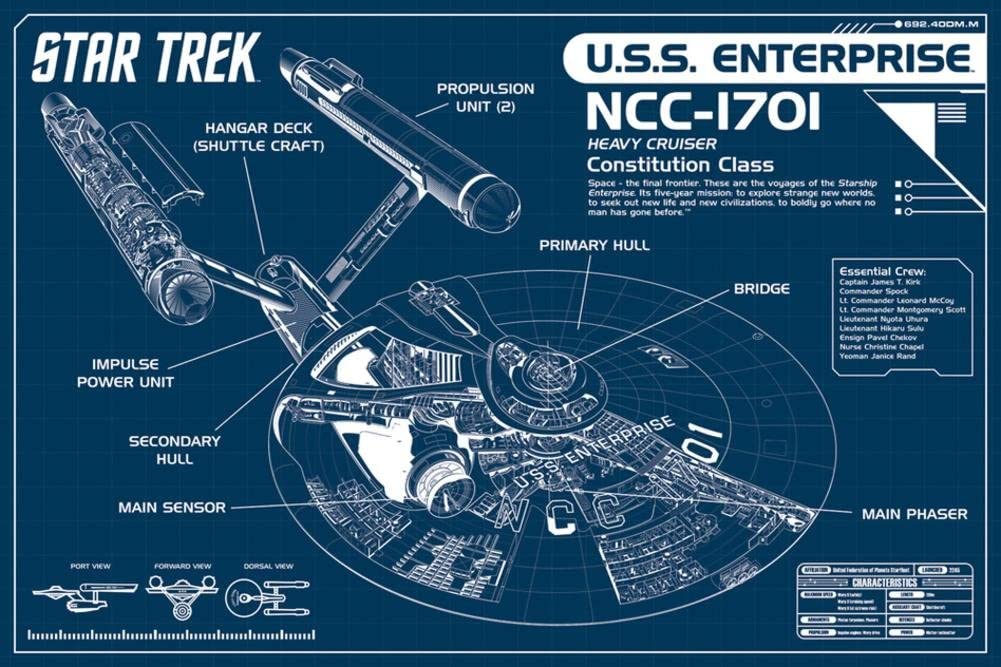
The USS Enterprise (NCC-1701-A) was a Constitution-class vessel operated by Starfleet in the 23rd century. It was the
second Federation starship to bear the name Enterprise. After the Enterprise-A was decommissioned and mothballed, it was succeeded by
the USS Enterprise-B. (Star Trek IV: The Voyage Home; TNG: "Relics"; Star Trek Generations) Externally, the Enterprise-A was virtually
identical to the refit USS Enterprise, destroyed several months prior to its launch. (Star Trek III: The Search for Spock)
The bridge was in its customary location on Deck 1. At least three different designs were used during the ship's service.
(Star Trek IV: The Voyage Home; Star Trek V: The Final Frontier; Star Trek VI: The Undiscovered Country)
Ship's interior: The bridge was located on Deck 1, at the very top of the saucer section. The large viewscreen could project different views from cameras scattered on the saucer section of the ship. The Enterprise could also show tactical views and alerts on the screen along with hails. There were two turbolifts. The torpedo bay was on Deck 13. It was much more automated than on the previous Enterprise, and the torpedo room itself was smaller and enclosed. No unauthorized hand phaser could be fired aboard the ship at a vaporizing level without an alarm sounding. (Star Trek VI: The Undiscovered Country) The shuttlebay, seperate from the cargo bay, was located at the rear of the engineering section.
Ship's interior: The bridge was located on Deck 1, at the very top of the saucer section. The large viewscreen could project different views from cameras scattered on the saucer section of the ship. The Enterprise could also show tactical views and alerts on the screen along with hails. There were two turbolifts. The torpedo bay was on Deck 13. It was much more automated than on the previous Enterprise, and the torpedo room itself was smaller and enclosed. No unauthorized hand phaser could be fired aboard the ship at a vaporizing level without an alarm sounding. (Star Trek VI: The Undiscovered Country) The shuttlebay, seperate from the cargo bay, was located at the rear of the engineering section.
Unlike its predecessor, the shuttlebay of the Enterprise-A was a separate and distinct area from the cargo bay. The ship had
at least two shuttlecraft, including the Galileo and the Copernicus. Normally, a tractor beam guided the shuttle to a landing. A large net barricade
could be erected to capture an incoming shuttle which was landing too fast or otherwise disabled. Officers had crew quarters similar to those on the
previous Enterprise. Enlisted crew members were required to bunk together. As many as eight crew members were assigned to a room, each assigned a
storage locker. Chimes sounded at the top of every hour. Meals were prepared in a galley. The Enterprise-A had a vertical warp core similar to that
of the Galaxy-class of eighty years later. The core could be accessed through main engineering on Deck 15. An isolation door could be brought down to
separate the core from the rest of the ship. (Star Trek VI: The Undiscovered Country) There was a crew lounge at the front of the ship which contained
several maritime relics, including a steering wheel from a sailing vessel inscribed with the ship's motto, "to boldly go where no man has gone before."
An emergency transmitter was also located in the lounge. (Star Trek V: The Final Frontier) There was a crew lounge at the front of the ship which
contained several maritime relics, including a steering wheel from a sailing vessel inscribed with the ship's motto, "to boldly go where no man has
gone before."
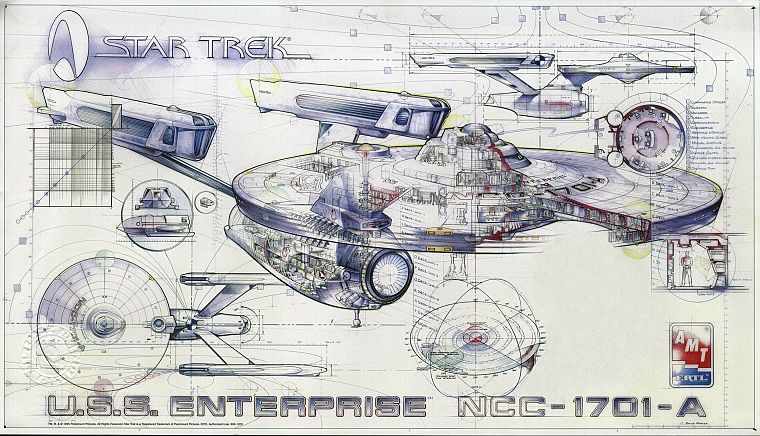
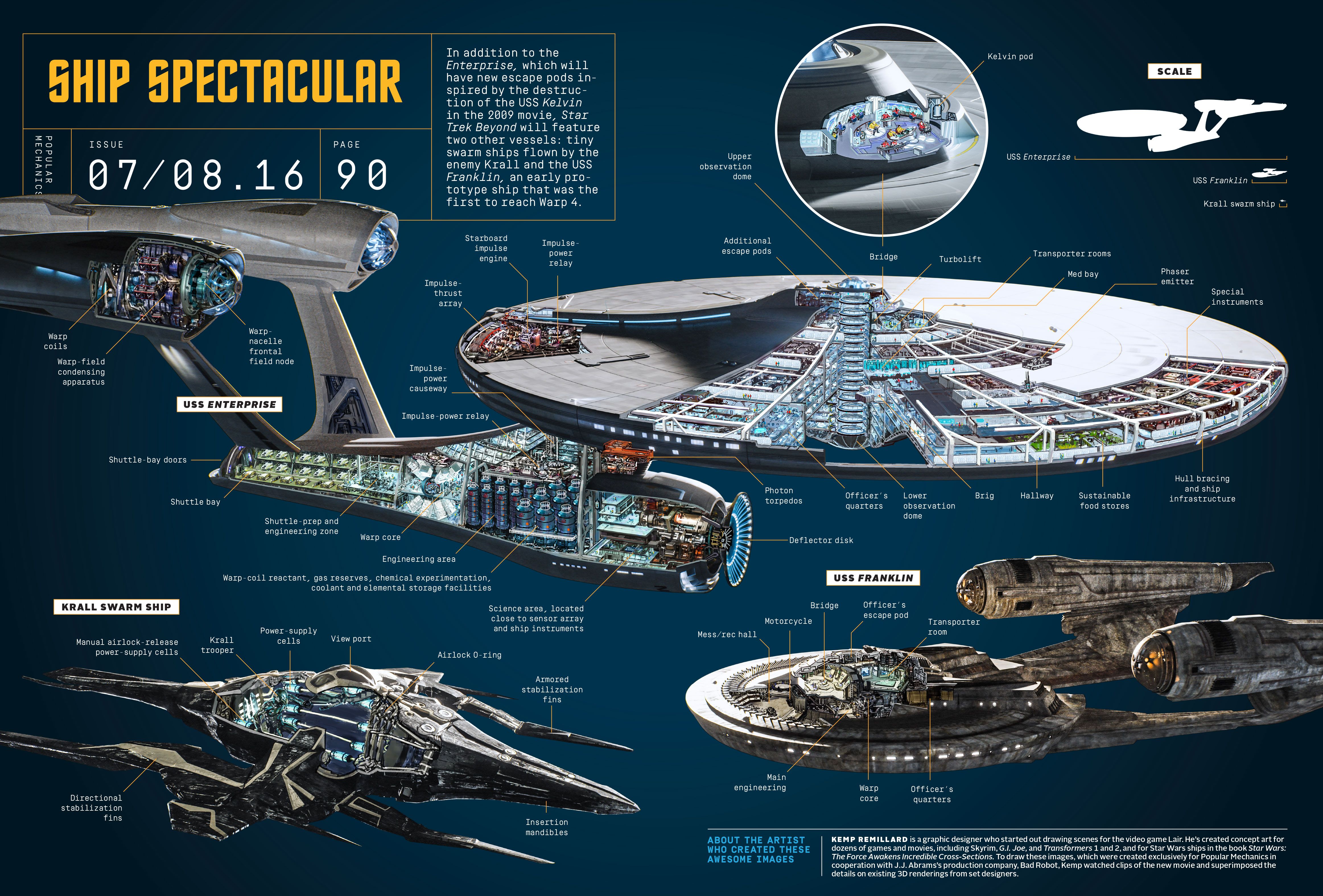
An emergency transmitter was also located in the lounge. (Star Trek V: The Final Frontier) The brig was located in the bowels of the
engineering hull. It was designed to be escape-proof, certified so by Captain Spock. The turbolift shafts were triangular in shape. In addition to
the normal corridors, there were full-height Jefferies tubes in the engineering hull. (Star Trek V: The Final Frontier)
In 2286, the Enterprise-A was commissioned at the San Francisco Fleet Yards on stardate 8442.5. It was launched from Spacedock on the order of the
Federation Council in appreciation of Captain James T. Kirk and his crew's efforts to prevent the Whale Probe from devastating Earth. The crew initially
thought they were going to be assigned to a "freighter" at best, according to Leonard McCoy or the USS Excelsior, but the new Enterprise was soon revealed,
docked next to the Excelsior. The crew took their stations and the Enterprise left Spacedock on a shakedown cruise. (Star Trek IV: The Voyage Home)
The shakedown did not proceed as planned, and the Enterprise limped back to spacedock for several weeks of repair under the supervision of Captain Montgomery
Scott. Although its warp drive was working perfectly, half the doors on the ship were malfunctioning and several control interfaces did not work. The transporter
was also nonfunctional, requiring shuttles to be used for off-ship missions. The U.S.S. Enterprise NCC-1701-A is a science fiction icon.